The Archaeology of Knowledge and the Future
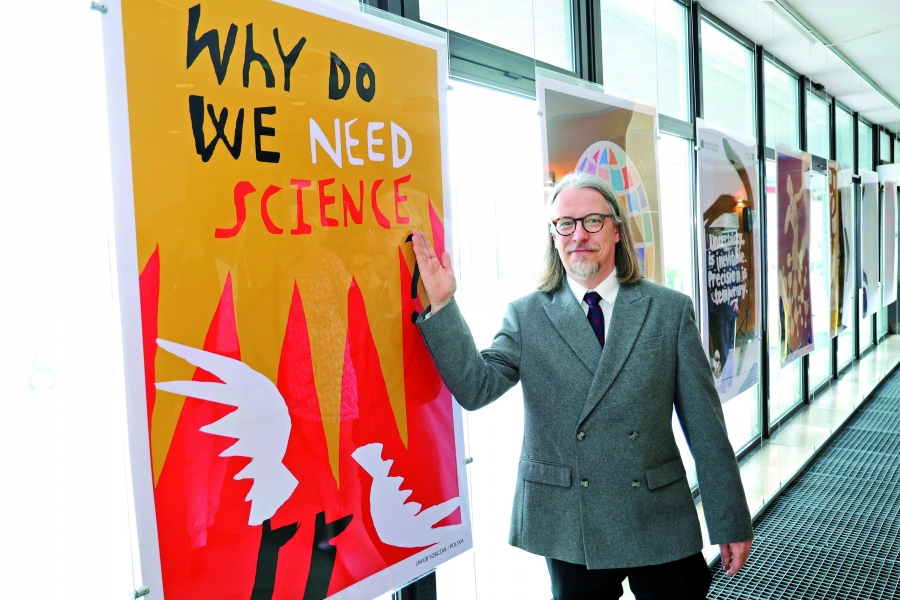
An interview with Adam Kola, Vice-Rector for Research at Nicolaus Copernicus University (NCU)
by Winicjusz Schulz
– When you say UMK—or perhaps NCU—what does that name evoke internationally?
It evokes several things at once. First, a solid, comprehensive research university from Central Europe. Second, an institution that in recent years has significantly accelerated both its research performance and its internationalization. And third, a place where tradition and modernity meaningfully intersect.
The name of Nicolaus Copernicus carries a certain responsibility. It immediately situates us within a global conversation about science and its transformative moments. When I introduce our university abroad, the reaction is almost always the same: a smile, followed by “Ah, Copernicus!” That recognition is a powerful symbolic asset—but also a commitment. It challenges us to think boldly about science ourselves.
At the same time, this symbolic capital rests on a very concrete institutional foundation. NCU is a fully-fledged, classical university in the best sense: strong in the humanities and social sciences—fields that have shaped its identity from the outset—while also possessing substantial strengths in the natural sciences and medicine, developed within the Collegium Medicum in Bydgoszcz, an integral part of the university. We are also increasingly expanding engineering and technological fields, aware that a modern research university must contribute to the creation of new technologies.
Our strength is best demonstrated not by declarations, but by results: publications in leading journals, prestigious grants, international recognition—but above all, by discoveries.
Recent examples illustrate this well. The team led by Professor Piotr Wcisło is advancing quantum technologies and ultra-precise measurement systems. At the Collegium Medicum, Professor Daniel Gackowski’s group has identified a new biomarker with significant implications for leukemia diagnostics. Meanwhile, Dr. hab. Maciej Kordowitzki’s work, published in CA: A Cancer Journal for Clinicians—one of the most influential medical journals globally—emerged from research conducted at Harvard University within the framework of our Excellence Initiative.
At the same time, our humanities research also has global reach. Professor Adam Izdebski’s work on the long-term history of pandemics, for example, offers insights directly relevant to contemporary post-COVID societies.
Equally important are publications with leading academic presses. Books such as Marta Szada’s Conversion and the Contest of Creeds in Early Medieval Christianity or Michael Pleyer’s Cognitive Linguistics and Language Evolution—both published by Cambridge University Press—demonstrate that research conducted at NCU is read and recognized worldwide.
Taken together, these examples point to a clear identity: NCU is increasingly perceived as an ambitious European research university. Our membership in YERUN—the Young European Research Universities Network—confirms this positioning. It is a network of institutions that share a commitment to excellence and active participation in the global research landscape.
– Let’s imagine NCU as a restaurant. What would be the signature dishes on the menu?
Certainly physics and astronomy—long-standing strengths—alongside archaeology and theology. Among newer areas, cognitive science stands out. Biological and medical research is developing rapidly, and we have excellent teams in Earth sciences, psychology, law, and economics.
But perhaps the defining feature of our “menu” is diversity itself. NCU is genuinely comprehensive. It allows different “languages of science” to meet: physicists with humanists, physicians with computer scientists, lawyers with biologists.
Increasingly, the most interesting research emerges precisely at these intersections. That is why we are investing in interdisciplinary teams—structures designed to connect scholars across fields in a horizontal way.
– You travel frequently. Which universities abroad are closest to NCU in character?
We are closest to medium-sized European research universities—institutions deeply embedded in their regions, yet globally oriented in their ambitions.
This includes universities in Central Europe—such as those in the Czech Republic or Estonia—but also in the Netherlands, Scandinavia, or Germany. We still have ground to cover in terms of visibility and global recognition. Yet structurally and culturally, we share much with institutions that are not necessarily the largest in their countries, but are highly research-intensive and outward-looking.
A good example is the University of Würzburg, with which we have long collaborated and are now building a strategic partnership.
– Research security has become a major topic recently. Is this truly a new challenge?
Yes—and a serious one. For decades, universities operated under a paradigm of openness: free exchange of knowledge, people, and ideas. We promoted open access, open data, shared infrastructure.
That remains fundamental. But the geopolitical context has changed.
We now face the challenge of research security—particularly in fields with dual-use potential, such as quantum technologies, artificial intelligence, or advanced materials. The question is no longer whether science should be open, but how to balance openness with responsibility.
This is not about closing science. It is about managing international collaboration more consciously and protecting strategically sensitive knowledge and infrastructure. Universities are learning to navigate this new equilibrium.
– You often emphasize the European dimension of university activity. What does that mean in practice?
Science today is inherently transnational. Research programmes, infrastructures, and collaborations operate at a European scale.
NCU is deeply embedded in this ecosystem. Through YERUN, we participate in shaping European research policy and future funding frameworks. We are also part of YUFE—Young Universities for the Future of Europe—one of the key alliances in the European higher education landscape.
These networks are not symbolic—they provide concrete opportunities: partnerships, funding, infrastructure access.
They matter not only institutionally, but for our researchers, students, and doctoral candidates.
– How does NCU position itself globally?
We must be realistic: the global academic landscape is highly competitive. But Polish universities, including NCU, are catching up rapidly.
The Excellence Initiative has been transformative. It enabled us to strengthen research teams, internationalize, publish globally, and attract top scholars.
The key challenge now is sustaining this momentum—especially as other regions, including Asia and the Middle East, are investing aggressively in research and higher education.
– What reforms would you import into the Polish system?
Above all: stability in research funding. Universities need long-term horizons—10 to 20 years—to plan strategically.
Second: trust. Less micro-regulation, less bureaucratic constraint, more institutional responsibility.
The paradox is simple: science thrives where freedom and responsibility coexist.
– And what could Poland export?
Energy.
Polish science is still in a phase of rapid growth—dynamic, ambitious, open to change. In contrast, some Western systems are already highly stabilized, even rigid.
This dynamism is a major asset.
– Are the humanities disadvantaged globally?
Not at all. While the natural sciences benefit from universal languages, they also face enormous infrastructural costs.
The humanities, by contrast, operate differently—but their questions are often deeply universal. The key lies in how those questions are framed.
– What about digital humanities?
A tool—not a paradigm.
Digital methods enable large-scale analysis, but they do not replace interpretation. The humanities remain fundamentally about meaning.
What changes is scale and evidential grounding—not the core epistemological task.
– And at NCU?
Digital humanities are developing dynamically, particularly at the intersection with data science.
Projects such as online dictionaries, textual corpora, memory studies linked to GIS, or digital bibliographies illustrate this well. These are not marginal activities—they represent a structural shift in how research is conducted.
– Your father was an archaeologist. Why didn’t you follow that path?
In a sense, I did.
Growing up among archaeologists shaped my thinking—especially the sense of working across long temporal scales, uncovering layers, discovering what is hidden.
Today, I work on the history and circulation of knowledge. It is, in a way, an archaeology of knowledge—excavating texts, archives, forgotten intellectual traditions.
– What fascinates you most in your research today?
The relationship between memory, knowledge, and power.
Especially in Central Europe—a region where history continues to shape the present in profound ways. What is happening today in Ukraine is part of a recurring historical pattern that becomes visible precisely through such research.
– What advice would you give young researchers?
Be curious. Be mobile. Be collaborative.
And above all—be persistent.
The main reason we fail in European grant competitions is not lack of quality, but lack of persistence. Others apply again and again. We often do not.
That must change.
– Finally—your working method?
Reading, conversation—and too much coffee.
And, when possible, archives. That remains the most absorbing part of my work.
Originally published in Polish in Głos Uczelni, Year XXXV (LII), No. 3–4 (427), April 2026 (ISSN 1230-9710; published since 1952), available online at: https://glos.umk.pl/wiadomosci/?id=44996
The interview is accompanied by photographs from the opening of the exhibition “Why Do We Need Art? Why Do We Need Science?” at Nicolaus Copernicus University in Toruń (photo: Andrzej Romański).